
Gota, dabka, resham, zari and mirror work: a simple guide to hand embroidery
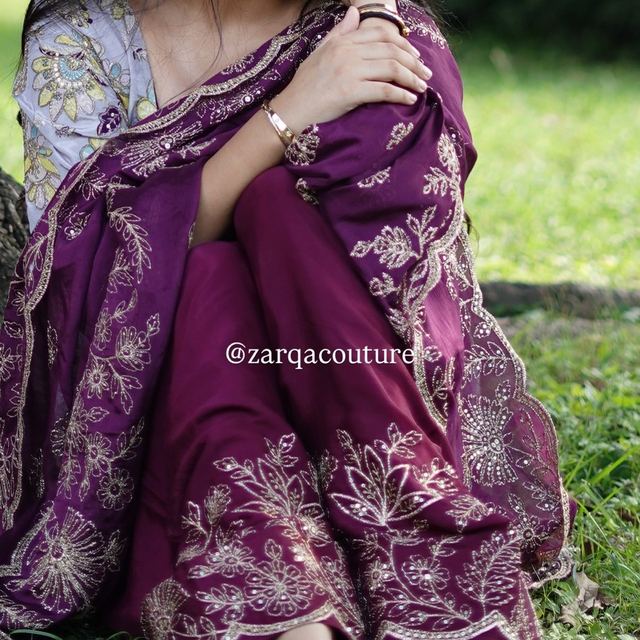
Product pages for Indian outfits are full of words like gota, dabka and resham. They all describe hand embroidery, but each one looks, feels and weighs very differently. Here is a simple guide, with the Zarqa pieces where you can see each kind.

Before any stitch, the design is traced onto the fabric in fine dots. Here the first motif has been worked in sequins and dabka.
Zari
Zari is metallic thread, in gold or silver, embroidered into patterns. It gives a soft shine and lies fairly flat, so it is lighter than zardozi. It suits festive pieces you want to glow without feeling heavy.
See it on: Afsana, where silver-gold zari flowers are worked across the patiala and the wide dupatta.
Gota
Gota is a ribbon woven from metallic thread. It is stitched on as a shining border, or cut and folded into leaves and flowers, which is called gota patti. It is closely linked with Rajasthan, it is light, and it catches the light beautifully in the day.
See it on: Afsana, with every edge scalloped and finished in gota, and Tehzeeb, where gota edges the zardozi.
Dabka
Dabka is a fine coil of metal wire, like a tiny spring, cut into pieces and stitched down in raised lines. It is part of the zardozi family and gives the richest, most three-dimensional look. It is heavier, so it is usually kept for bridal and evening pieces.
See it on: Tehzeeb, our bridal sharara.
Resham
Resham means silk, and resham work is embroidery in silk or silky thread. It comes in every colour, has a soft sheen, and keeps an outfit light, which makes it easy to wear for long hours.
See it on: Andaaz, in midnight-navy crepe with resham embroidery and embroidered net cuffs.

Resham thread-work in progress: the traced lines show where the next flowers will go.
Mirror work
Small round or shaped mirrors, called shisha, are held in place by a ring of stitches. Mirror work sparkles as you move and has a joyful, festive feel, perfect for a mehndi or a sangeet.
See it on: Afsana, with mirror centres in the zari flowers, and Suhag, with a scalloped mirror cut-work border on the kurta and patiala.
Sequin and pearl
Sequins (sitara) and pearls (moti) are stitched on one by one, scattered as sprays or packed into shapes. They bring a modern shine and look wonderful under evening lights.
See it on: Andaaz, with sprays of sequin and pearl flowers over the hip, and Aurelle, our first gown, where navy flowers are filled with tiny beads (Aurelle is on pre-order).

Sequins and pearls sewn one by one around a neckline on organza.
Thread-work and buti
Thread-work uses cotton or silk thread to draw flowers, vines and borders. A buti is a small motif repeated across the fabric. Together they give an outfit texture and colour without weight, which makes them ideal for day functions.
See it on: Shahana, where gold and ivory floral sprays climb the sleeves of black silk, and Mehreen, with an ivory thread yoke, small flowers and crochet lace.
How much hand-work should you choose?
- Day functions (haldi, mehndi, family lunches): thread-work, resham, light gota or mirror work.
- Evening functions (sangeet, cocktail, reception): sequin, pearl, mirror and zari for shine.
- Your wedding day: zardozi and dabka, the richest work of all.
At Zarqa, our karigars do all of these by hand. See all our pieces, or send us your own design and we will make it in hand-work.