
What is zardozi? The raised gold hand-work on a bridal outfit
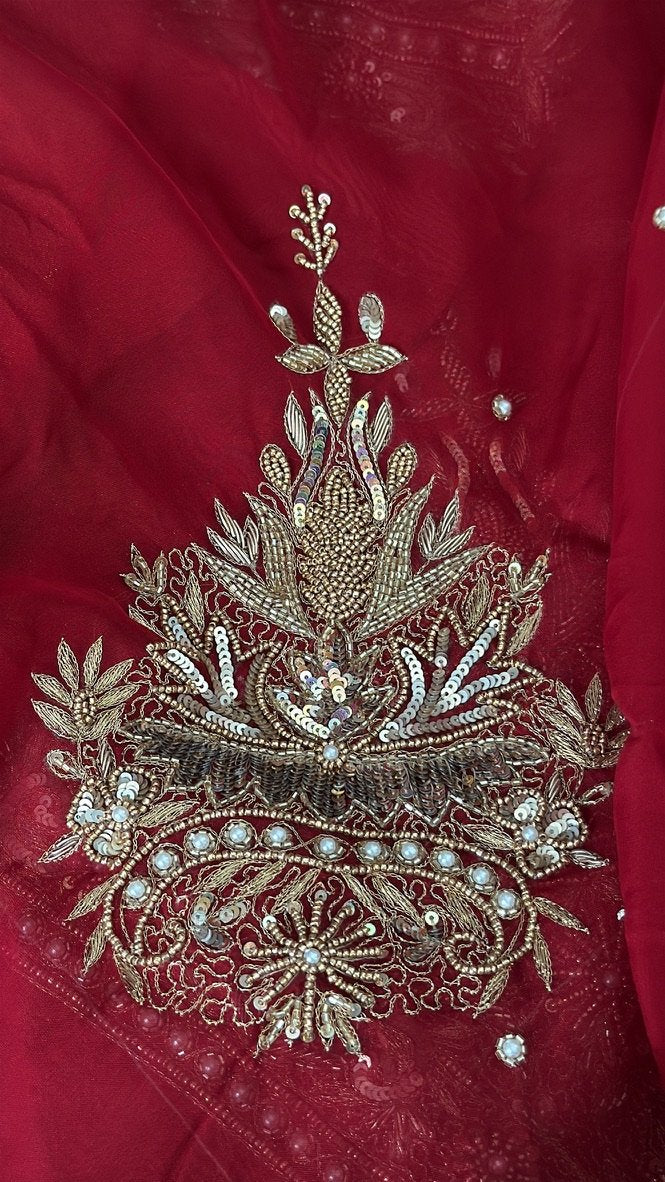
If you have ever run your hand over a bridal outfit and felt the gold rise off the fabric, that is zardozi. It is one of the oldest and richest kinds of Indian hand embroidery, and it is the work you see along the hem and cuffs of our Tehzeeb bridal sharara.
What the word means
Zardozi comes from Persian: zar means gold and dozi means embroidery. It came to India centuries ago and flourished at the Mughal courts, where it decorated royal clothes and furnishings. Today it is still the embroidery most brides picture when they think of a wedding outfit.
What it is made of
Zardozi uses metal threads and fine wire instead of ordinary thread. Long ago these were real gold and silver. Today most zardozi uses metallic threads with a gold or silver finish, which keep the shine while making the work lighter to wear. Alongside the wire, karigars add sequins (sitara), beads, pearls and small stones.
How it is made
The fabric is stretched tight on a wooden frame called an adda. The karigar sits at the frame with a fine needle, placing each piece of wire or sequin by hand and stitching it down. Inside zardozi there are several techniques:
- Dabka: a fine coil of wire, like a tiny spring, cut into short pieces and stitched down so it lies in raised, textured lines.
- Nakshi: a thin twisted wire that gives a fine, sparkling surface.
- Salma: a smooth, shiny coil used for bold outlines and filled shapes.
- Sitara and pearls: sequins and beads set in between to catch the light.
A dense border can take days of work at the frame. That is why real hand zardozi is never quick, and why it looks so different from machine embroidery.

An organza dupatta laced to the adda, with its border of sequins and pearl flowers being worked by our karigars.
How to tell hand zardozi from machine work
- It is raised. Run your fingers over it. Hand zardozi has height and texture; machine embroidery lies flat.
- It is a little uneven. Look closely and every coil sits slightly differently. Perfect repetition usually means a machine.
- Check the back. Hand-work shows short holding stitches; machine work shows long, regular runs of thread and often a stiff backing sheet.
- It has weight. A zardozi border makes the fabric fall heavily and beautifully.
Caring for zardozi
- Dry clean only, and tell the cleaner that it has metal work.
- Store it folded flat, wrapped in soft cotton or muslin, not in plastic.
- Do not leave a heavy zardozi piece on a hanger for long; the weight pulls the fabric.
- Put on perfume before you dress, never straight onto the embroidery.
- Air it every few months so damp does not dull the metal.
- If you need to iron, iron on the back with a cloth in between, never directly on the work.
Zardozi at Zarqa
At Zarqa, our karigars do zardozi entirely by hand. You can see it on Tehzeeb, where raised zardozi and dabka run along the hem and cuffs, finished with gota edging and a dupatta edged in hand-strung pearl drops. If you have a zardozi design in mind, send it to us and we will make it for you in hand-work.

A zardozi neckline and motif on velvet, still on the frame: dabka, sequins and pearls, placed one by one.